AI-First Operating Model




Definition
An AI-First Operating Model is an operating logic in which AI is planned from the start as an integral part of how people, processes, data and technology work together. I describe it through five building blocks (capabilities, context, guardrails, execution and feedback), held together by leadership.
Five building blocks, held together by leadership.
3
stages from tool to operating model
5
building blocks that only work together
3
autonomy levels for agents
100
days to get started, in five steps
01 · Why now
Why the topic belongs on the executive agenda
Most companies use AI tools, and yet the expected return often fails to materialize. That’s rarely down to the technology. Usually AI is dropped into the existing operating logic, and the processes behind it stay as they were.
Processing information used to be the time-consuming part of knowledge work, and coordination barely registered. AI flips that relationship. Analysis and preparation take hardly any time anymore, so approvals and handoffs become the bottleneck. If nothing changes there, you get faster individual tasks in an organization that decides just as slowly as before.
Tool logic
Impact: AI speeds up individual tasks
Measurement: Licenses and usage rates
Ownership: usually IT
Operating logic
Impact: AI changes who decides with what information
Measurement: Cycle time and quality of decisions
Ownership: leadership itself
In practice
I see this pattern in my own work, too. With vibe coding tools, even people without programming skills can draft a landing page or a prototype in a few hours that used to take days or weeks. But turning that into a robust product requires integration with existing systems, data protection reviews, testing and alignment with several departments. If that path isn’t mapped out beforehand, the time saved evaporates in the system.
02 · Three stages
Three stages: tool, process, operating model
A company can get from the first to the second stage through hard work and discipline. The step to the third stage takes decisions about responsibilities and budgets that only the executive team can make. That’s the threshold where most companies stall.
1
Tool
Individuals get more productive, processes stay the same.
Overbeck: 400 licenses rolled out
2
Process
AI is a fixed step in a process. Measurable impact, but limited.
Overbeck: 2 of 14 pilots
3
Operating model
Processes redesigned from the outcome backward, teams formed around outcomes, autonomy set for each step.
This is where most companies stall.
The three stages in detail
At the first stage, AI is a tool. Employees use it to draft emails or summarize documents and become more productive individually. The company’s processes stay the same, and the gains are spread across so many shoulders that they barely register in the organization. Overbeck, the hydraulics manufacturer in the case study from my book, has rolled out 400 AI licenses and is right at this stage.
At the second stage, AI becomes a fixed step in a process. An application matches incoming complaints to known failure patterns, and a model reconciles supplier invoices with purchase orders. The impact can be measured but stays limited to individual processes that are essentially built the way they were before. Of fourteen pilot projects at Overbeck, two have reached this stage.
At the third stage, AI changes the operating model itself. Selected processes are redesigned from the desired outcome backward, teams form around outcomes, and for every step it’s defined how independently an agent may act.
03 · Five building blocks
The five building blocks
Four of the building blocks stack on top of each other like the floors of a building. The fifth, feedback, makes sure the building gets better with every use.
4ExecutionSmall, cross-functional teams with agents as a fixed part
Execution is about who does the work in which setup and which tasks a human or an agent takes on. The direction is toward small, cross-functional teams that own an outcome together and in which agents are a fixed part of the team.
For every step of a process, one of three autonomy levels is set. At the lowest, the agent prepares and a human decides. In the middle, the agent handles routine cases while a human reviews exceptions and spot checks. At the highest level, the agent acts on its own within fixed limits, and a human monitors the result through metrics and warning signals.
3GuardrailsDecision rights, liability, data protection, EU AI Act, co-determination
Guardrails set the framework within which people and agents work. They cover decision rights and liability, data protection, the requirements of the EU AI Act and the works council’s co-determination rights. This is one of the biggest bottlenecks. Well-set guardrails make agents faster, because it’s clear how far they may go.
2ContextThe knowledge people and agents need for their work
Context is the knowledge people and agents need for their work. It includes customer and product data, pricing logic, past decisions and the reasons behind them. The key question is whether systems can access this knowledge or whether it sits in inboxes and personal folders. At Overbeck, much of it lives in the heads of three design engineers, one of whom retires in two years.
1CapabilitiesThe processes that create value, redescribed from the outcome backward
By capabilities, I mean the processes a company uses to create value, such as preparing quotes or handling a complaint. The transformation starts by redescribing some of these processes from the outcome backward. It often turns out that knowledge about a process exists only in the heads of a few experienced people and is written down nowhere. Three to five processes are enough to start.
5
Feedback
Every correction flows back into processes and context
Read more
Every correction and every error flows back into the processes and the context. That requires measuring impact and learning loops within teams. Just as important is a culture in which employees report an agent’s mistakes instead of quietly fixing them themselves. Without feedback, an AI initiative remains a project that eventually gets closed out. With it, it becomes a system you maintain and that learns with every use.
Autonomy for each step
The agent prepares, a human decides
A human reviews exceptions and spot checks
Within fixed limits, monitored through metrics
What holds the building blocks together
A single team can largely shape its own processes and context. For an entire company, someone has to decide which processes get rebuilt first and who carries the budget. That task belongs to the executive team and can’t be delegated to a central technology team.
The building blocks depend on each other. A redesigned process fails on unresolved guardrails, and a smart role model is of little use if the context sits in silos.
If you only work on one building block, you just move the bottleneck somewhere else.
04 · In practice
What this looks like in practice
An agricultural machinery maker requests a hydraulic power unit that isn’t in the standard catalog.
8 days
until the quote goes out
3 hrs
of actual work
−20 min
saved by the AI assistant. It does nothing for the 8 days.
Today
- Process never written down end to end
- Knowledge in four systems and a few heads
- Approval threshold unchanged for 15 years
- Nobody owns the response time
Redesigned
- Agent matches the request against past cases
- Engineer only reviews cases with no template
- Approval depends on the risk
- Every result flows back into the context
Read the full case
An agricultural machinery maker, a longtime Overbeck customer, emails a request for a hydraulic power unit with higher flow capacity and a connection size that isn’t in the standard catalog. Inside sales waits one day for engineering and two more for purchasing. Because the quote exceeds the approval threshold, the head of sales, who is at a trade show, still has to sign off. After eight business days, the quote goes out. The actual work took about three hours.
The new AI assistant writes the quote text in ten minutes instead of thirty. That does next to nothing for the eight days.
Apply the five building blocks to this process, and the levers are elsewhere. Nobody has ever written down the process for special requests end to end. The information needed is scattered across four systems and the experience of a few design engineers. The approval threshold was set fifteen years ago and never reviewed since. Three departments work on the quote, but none owns the response time. And in the end nobody finds out whether the quote turns into an order, so the next similar request starts from scratch again.
Redesigned, an agent would match the request against past cases, pull similar variants from the engineering archive and propose a price. A design engineer would only review cases with no suitable template. Approval would depend on the quote’s risk, and every result would flow back into the context. None of these changes can be implemented by IT alone, because each one touches responsibilities and habits in the company.
05 · What it isn’t
What an AI-First Operating Model is not
While researching my book, I kept running into three misconceptions that make getting started harder.
Misconception
AI-first means full automation
In many processes, it’s right for a human to review or take responsibility.
Misconception
Clean up all data first
Accessible and good enough for the selected processes is enough.
Misconception
Own models or platform
Interchangeable models, focus on what makes your company distinctive.
The misconceptions in detail
The first is that AI-first means full automation. In many processes, it’s right for a human to review a suggestion or take responsibility for the outcome. That’s why the decision about AI’s share looks different when approving a quote for a key account than when checking a standard invoice.
The second misconception is that you first have to get all your data in order. I consider well-maintained data very important, but no company has perfect data. It’s enough if the data is accessible and good enough for the selected processes. Working on a concrete process quickly shows what’s missing.
Third, many believe they need their own models or their own AI platform. For most companies, that isn’t worth it. A portfolio of interchangeable models and a focus on what makes your company distinctive make more sense. At Overbeck, that’s seventy years of hydraulics experience, not a homegrown language model.
An AI-First Operating Model is also not an IT project you put out to tender and sign off on. For an established company with a works council and a grown IT landscape, it doesn’t mean rebuilding everything at once either. You start with the processes where the transformation delivers the biggest leap.
06 · First 100 days
Getting started: the first 100 days
The first 100 days determine whether the transformation gets a direction. For this period, I recommend five steps in a fixed order for leadership teams.
- 1InventoryWeeks 1–2
- 2Place your stage½ day with the leadership team
- 3Pick 3–5 processeswith a goal and an owner
- 4Minimal guardrailsRegister, risk classes, works council
- 5Visible leadershipthe most important step
- It starts with an honest inventory of ongoing AI initiatives and agents and what they’ve delivered so far. It takes one to two weeks and usually turns out sobering.
- Next, the leadership team sets aside half a day for each member to place the company at one of the three stages. The assessments often differ surprisingly widely, and that’s exactly what’s worth discussing.
- Then comes the selection of three to five processes with high volume and high friction. Each gets an owner and a goal that can be stated in one sentence with a number.
- Minimal guardrails are needed: a register of all agents, a classification into risk classes and a rule on which data may go into which tools. That includes a first conversation with the works council.
- Finally, visible leadership. The executive team uses AI itself and talks openly about it, including mistakes. I consider this step the most important, because it determines whether the organization takes the other four seriously.
07 · Metrics
How to measure progress
Cycle time
of important decisions
Escalation rate
how often things get escalated
Rule-based decisions
share made automatically
Decision quality
assessed in retrospectives
Not meaningful: licenses and usage rates.
Licenses and usage rates say little about whether the organization is changing. I prefer to look at the cycle time of important decisions and how often things have to be escalated. The share of decisions made automatically according to clear rules is also revealing. The quality of decisions is best assessed in regular retrospectives.
08 · FAQ
Frequently asked questions
Who has to own an AI-First Operating Model?
The executive team. Only it can decide which processes get rebuilt first and who carries the budget. In addition, every individual process needs a person who owns it across departmental boundaries.
Can AI agents make decisions on their own?
That’s set for each step of a process individually. An agent can make suggestions, handle routine cases with human review or act within fixed limits under supervision. A human is always accountable for the outcome.
Does our data have to be completely cleaned up first?
No. It has to be accessible and good enough for the selected processes. If you wait for perfect data, you’ll never start.
How long does the transformation take?
The first 100 days set the direction. After that, the model grows process by process, over the first year and the years that follow.
Do executives need to work with AI themselves?
Yes. Anyone who has to decide what AI may take on needs to know its limits from their own experience. And the organization watches very closely whether the executive team does what it asks of others.
Further reading
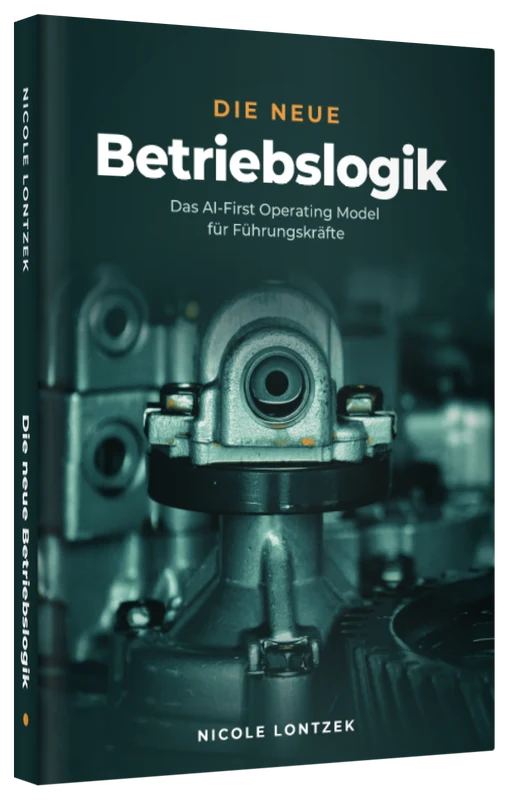
- Book: Die neue Betriebslogik. Das AI-First Operating Model für Führungskräfte (German edition, now available)
- Analysis in Computerwoche (German): So geht ein AI-First-Betriebsmodell
- The Tool Zoo and Other Wrong Turns in AI Adoption
Now available
Die neue Betriebslogik
“Die neue Betriebslogik” describes the five building blocks in detail, with the Overbeck case study, practical tools and a roadmap for the first 100 days. German edition.
About the author
Nicole Lontzek is a member of the executive management team at a software engineering company, an author and a certified supervisory and advisory board member. She writes and speaks about how leadership and organization are changing in the age of AI. View profile